The Journey

Every iteration of the Alpha Shift homepage exploration, in order - from the first blind field to the working synthesis. Internal review surface for One Roll Studios. Old rounds are archives, shown as built at the time.

How to review: open anything; add ?review to a URL for the brand menu on current candidates. The recommendation trail lives in the final band.

R2 - Blind field

Preview of Switchboard

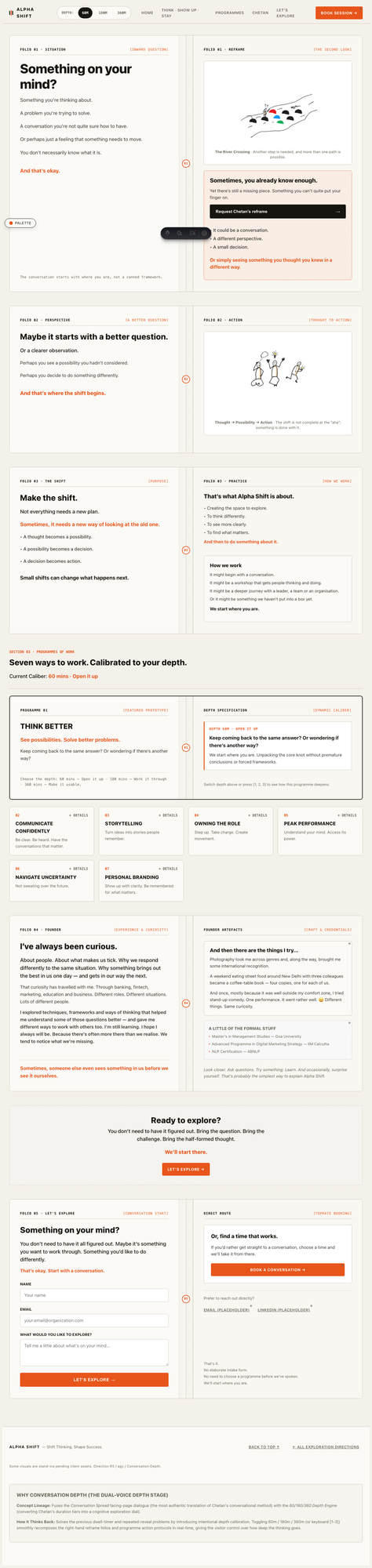
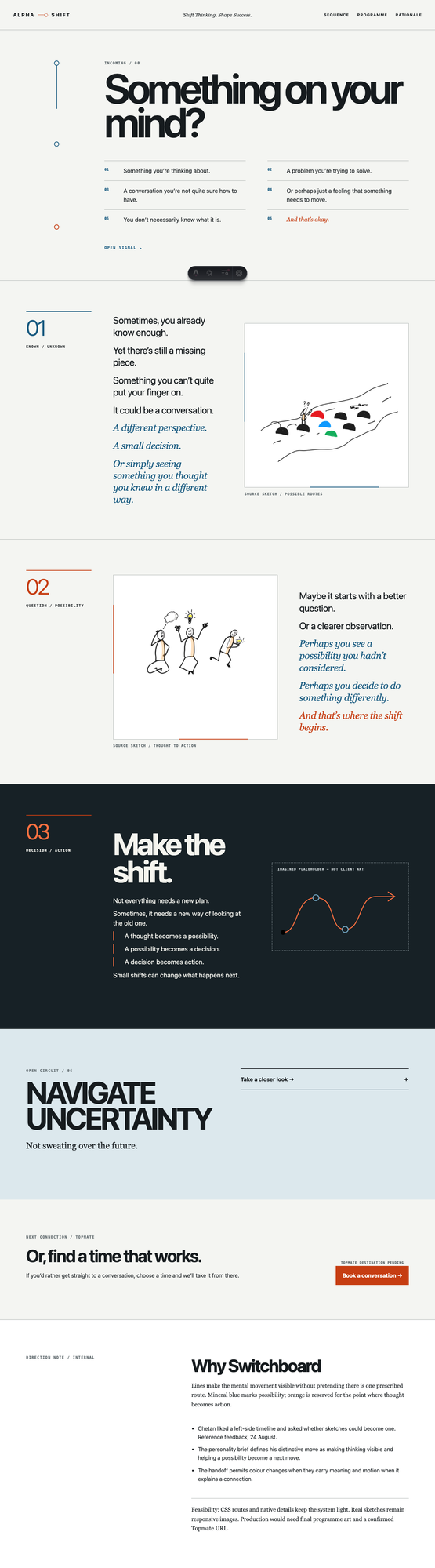
Switchboard

codex

As built at the time, a routed signal spine made possibility and action visibly distinct, with orange reserved for decisions. The field kept the idea of a line changing meaning, but the blue, coordinates and control-system language made a human conversation feel like infrastructure.

Preview of The Contact Sheet

The Contact Sheet

opus

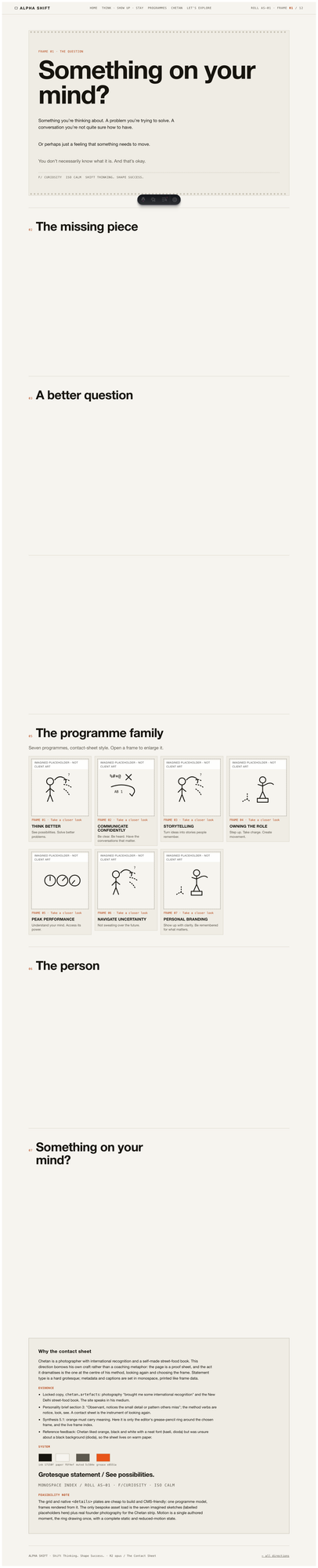
Chetan's own craft as the site's grammar: the page composed like a photographer's contact sheet, the one orange a grease-pencil ring drawn around the frame that is the one. It scored high on authenticity in the field and taught the lesson that borrowing the client's real medium reads as honesty, not theme. As built at the time: the ring was a single authored moment, shown already-drawn under reduced motion.

Preview of The Cut

The Cut

codex

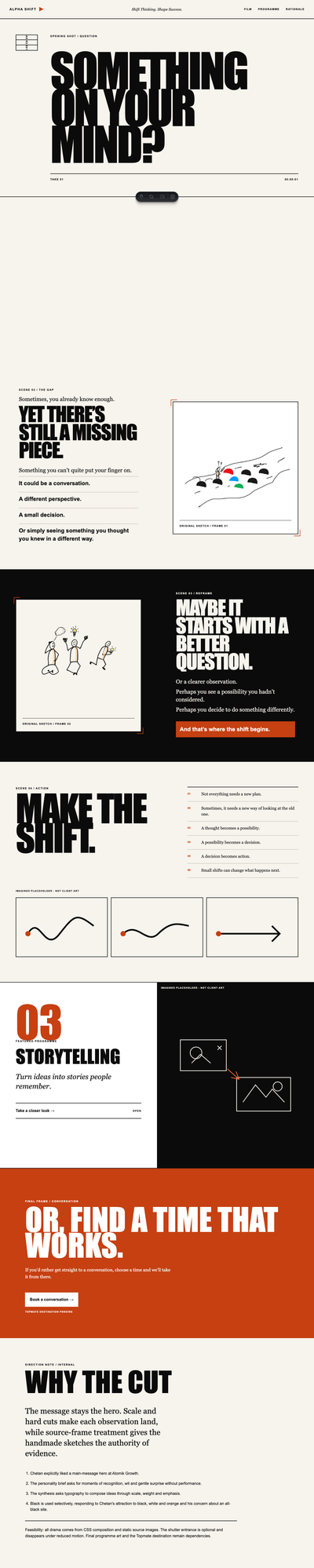
As built at the time, hard editorial cuts and crop-marked sketches made the opening message immediate and treated Chetan's drawings as source frames. The crop treatment survived as a useful organ, but the oversized condensed type shouted, tired the page at full length and carried too much display scale onto mobile.

Preview of The Through-Line

The Through-Line

opus

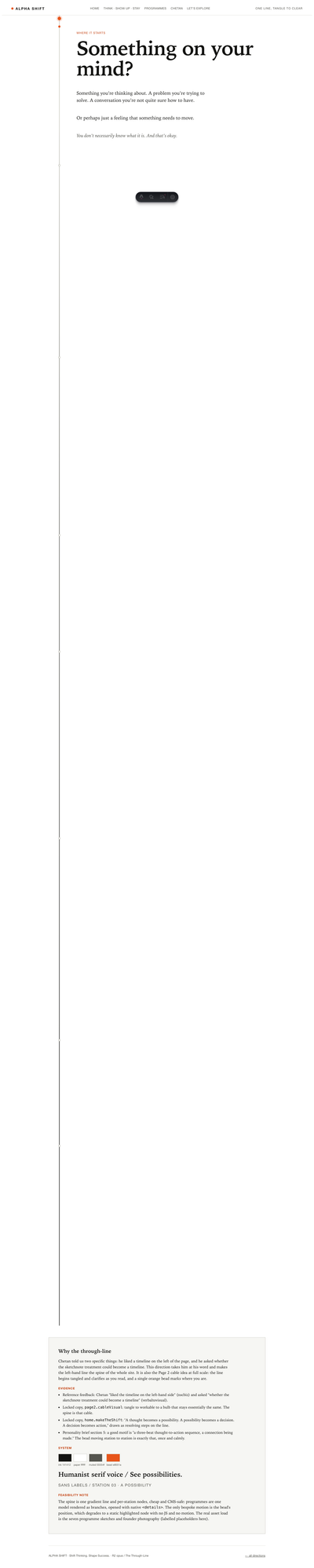
One line runs the whole length of the site, tangled at the top and clarifying as you descend; each section is a station hung to its right. It proved a line can be a spine, structure without a grid or a centred column, an idea that carried through to the v2 Left Spine and the D3 final. As built at the time.

Preview of At the Table

At the Table

codex

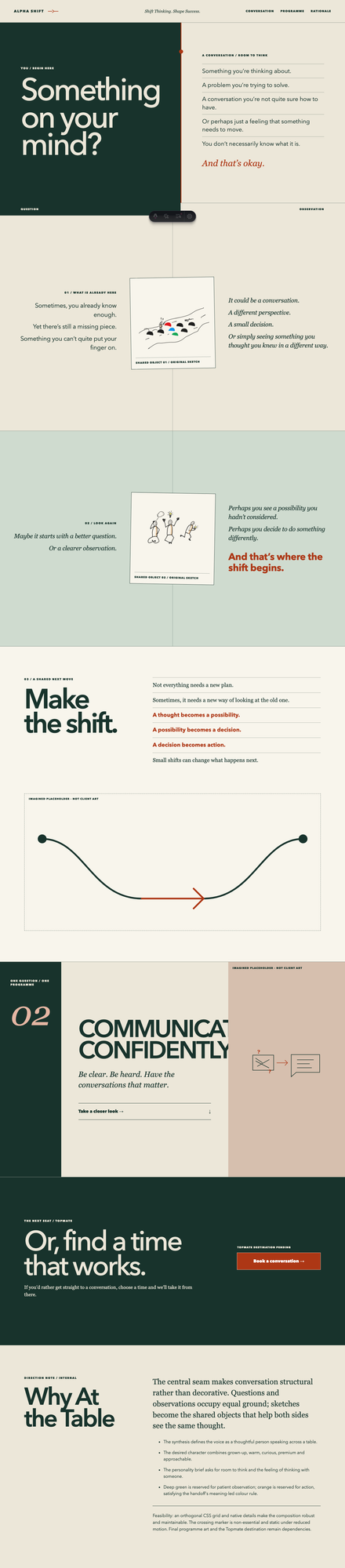
As built at the time, two conversational sides shared a centre seam and let the real sketches occupy the space between them. It was one of the warmer, more specifically human R2 systems, but the paired voices became too tidy a metaphor, the deep green missed the clearest palette signal and the looping marker decorated more than it explained.

Preview of Changing Light

Changing Light

opus

The site as one room whose light warms from cool grey toward orange as the thinking moves toward action, colour used as narration rather than decoration. The warming-accent bet became a recurring organ, later carried into The Darkroom and the R5 Developing Proof. As built at the time: the whole-surface temperature ramp was ambitious and hardest to keep legible at the cold end.

Preview of The Dialectic (r2/agy)

The Dialectic (r2/agy)

agy

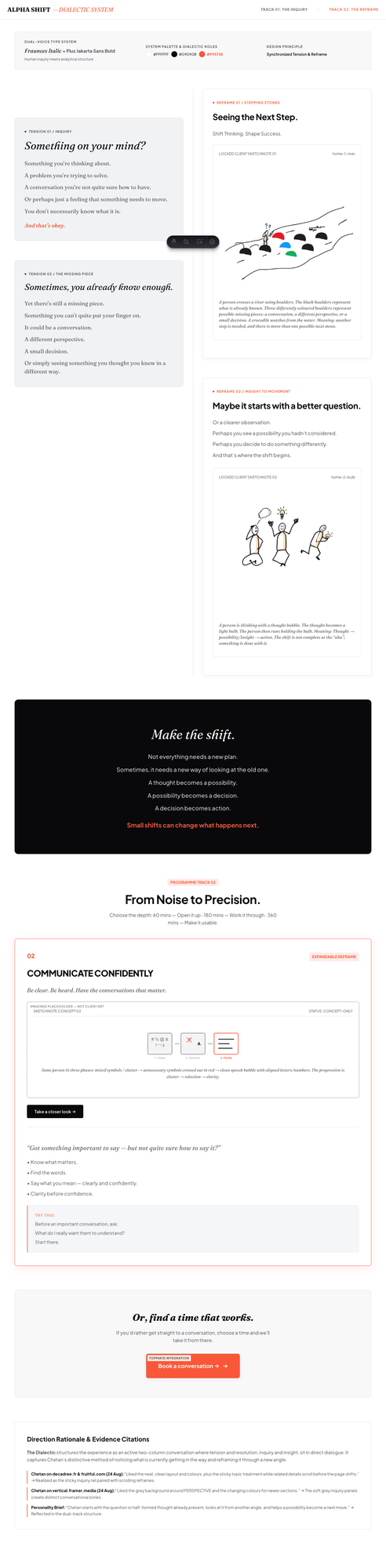
A two-column inquiry grid placing the human opening question on a sticky left rail against an alternating dialogue track. Taught conversational pacing, but failed as it felt uncomfortably close to a messaging chat app and stacked awkwardly on mobile. Shown as built at the time.

Preview of The Workshop Studio (r2/agy)

The Workshop Studio (r2/agy)

agy

An architectural plate-based layout exploring raw unstructured thinking intake and mechanical workshop notes. Proved tactile industrial density is possible in code, but failed by feeling overly cold, mechanical, and clinical for Chetan's humane strategic counsel. Shown as built at the time.

Preview of The Waypoint (r2/agy)

The Waypoint (r2/agy)

agy

A vertical traveling waypoint spine linking conversation nodes to progressive chapter reveals down the page. Established early narrative wayfinding, but failed on narrow viewports where the persistent spine choked content margins and created vertical scroll drag. Shown as built at the time.

R3

Preview of Proof Atlas

Proof Atlas

codex

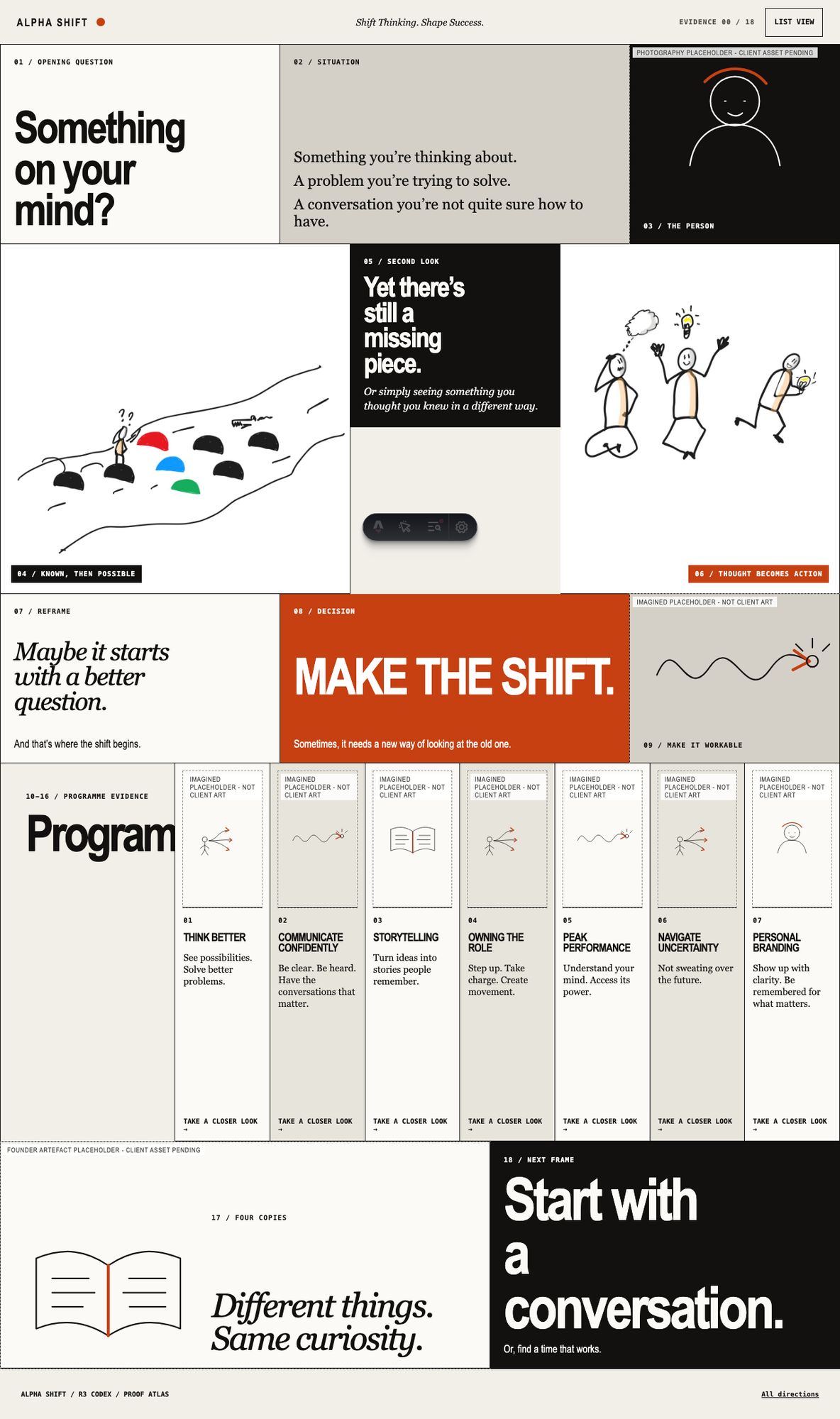
Proof Atlas turned attention into the edit: focus drew an orange grease-pencil mark, and selection reorganised a field where the real sketches carried unusual structural weight. The field learned that observation can become behaviour, but its indexed evidence language made Chetan feel curated by an institution rather than met as a person.

Preview of The Register

The Register

opus

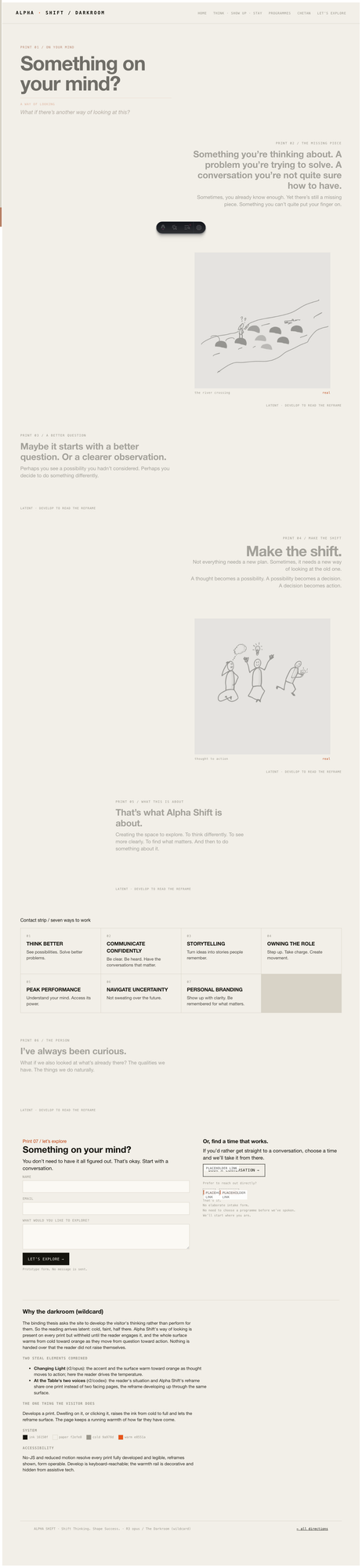
The page as a ruled register of numbered frames on one 12-track grid, no centred column anywhere; a single cell ignites orange, and clicking a shift-frame re-reads the same locked line with the weight thrown onto a different word. Three juries named it the field's best complete visual system. It proved geometry-not-column, and that the second look can be enacted by the reader rather than performed at them.

Preview of The Fold

The Fold

codex

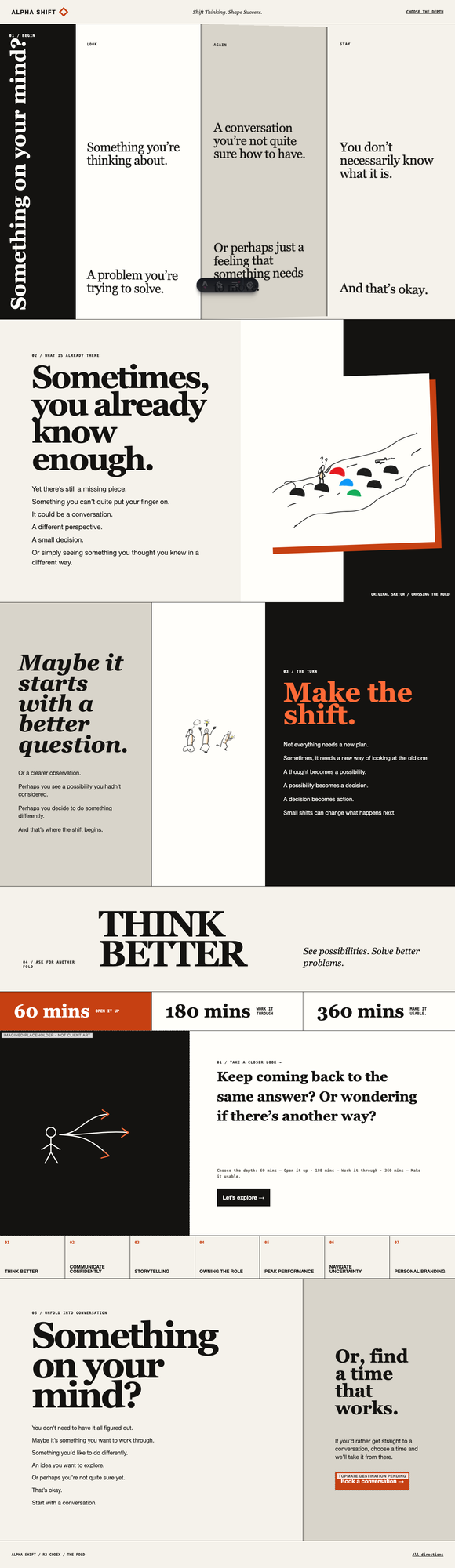
The Fold made each large gesture do narrative work, including a real sketch crossing the paper-to-black hinge and a 60/180/360 choice that genuinely recomposed one programme. It became the strongest Codex whole-system contender of the early field, yet its facet navigation and mobile snap sequence risked becoming art direction to admire rather than an interface to understand.

Preview of The Darkroom (wildcard)

The Darkroom (wildcard)

opus

A developing reading: each passage a cold, latent print the visitor raises to full by engaging it, the whole surface warming as they move through. Its honest failure was self-audited and named, it withheld legibility until engaged, gating attention as if attention were choice. That crime became the central thing the R5 Developing Proof fixed head-on, so the mistake taught the field more than the build did.

Preview of The Conversation Spread (r3/agy)

The Conversation Spread (r3/agy)

agy

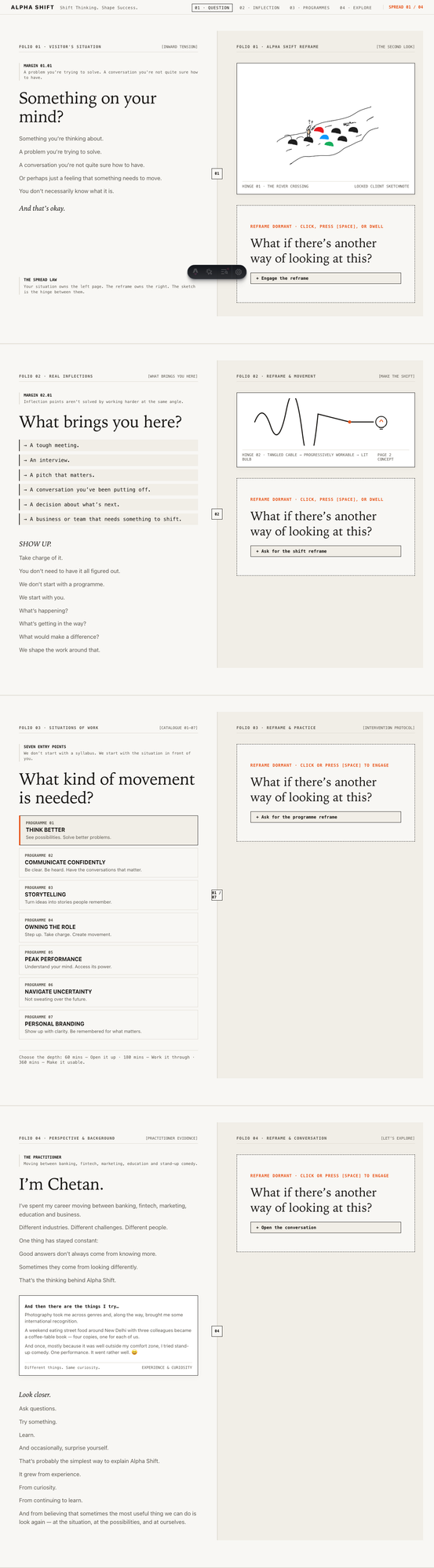
Full-width facing-page editorial spreads pairing question and reframe across an open-book gutter hinge. Showed the power of generous publication white space, but failed on mobile where the facing-page book metaphor collapsed into a standard linear stack.

Preview of The Depth Matrix (r3/agy)

The Depth Matrix (r3/agy)

agy

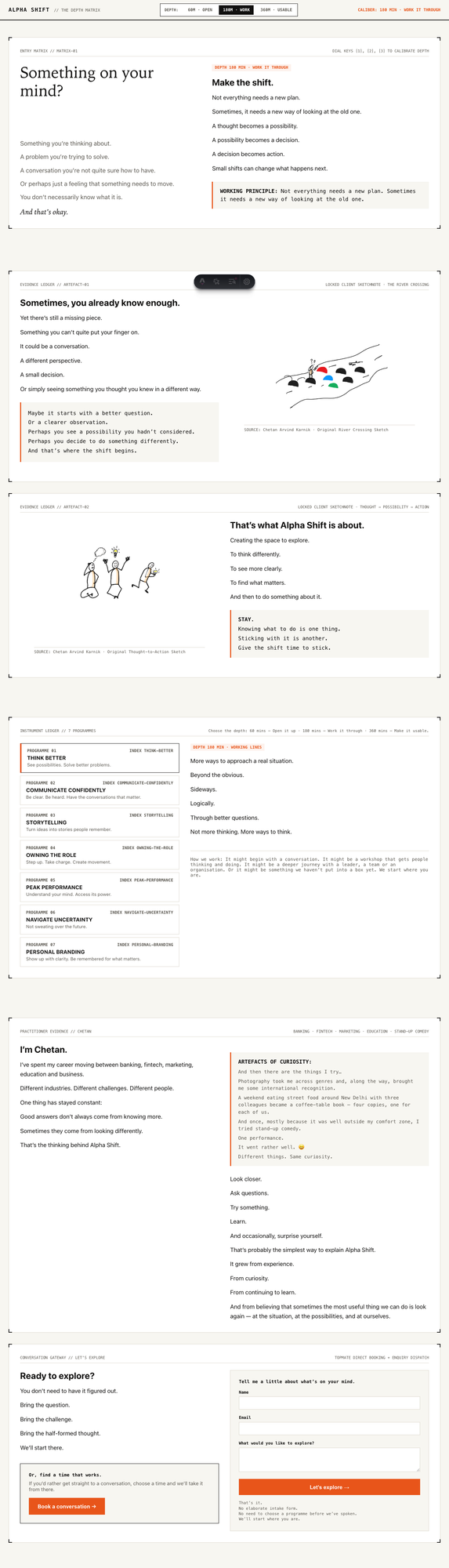
A wildcard analytical workbench testing multi-depth recomposition across 60/180/360-minute engagements with crop-mark technical framing. Introduced calibrated depth modes, but failed by forcing visitors to select their cognitive depth before reading any core thinking.

v2 shapes

Preview of The Left Spine (v2 shape anatomy)

The Left Spine (v2 shape anatomy)

opus

Four shape-anatomy passes (opus-1..4 at /v2/shapes/*) testing one bet in isolation: a persistent left rail as the page's backbone, sketch milestones riding it, one living mark descending it. The winning anatomy was built out as The Left Spine. It taught that the Through-Line's spine could carry real furniture, which fed straight into the D3 final. As built at the time: the shapes are deliberately rough skeletons, probes rather than candidates.

Preview of Four Shape Schematics (v2/agy)

Four Shape Schematics (v2/agy)

agy

Four lo-fi spatial schematics exploring left rail, central gutter, stepped horizon, and margin ledger. Focused the team on spatial relationships, but stepped horizon proved too fractured and margin ledger too busy; only center gutter advanced.

Preview of Centre-Gutter Dialogue (v2/agy)

Centre-Gutter Dialogue (v2/agy)

agy

Synthesized shape 2 into a deep build with an axial spine, alternating inquiry columns, and a mark-and-return tray. Validated central choreography, but failed by forcing tiring zigzag eye saccades across the axis over long reading distances.

R5 - Full builds

Preview of Marked Register

Marked Register

codex

Marked Register rebuilt the field's mark-and-return idea as a complete homepage: a visitor could keep familiar lines and meet those exact thoughts again before the enquiry. The consequence was useful, but the ruled document voice still risked overpowering Chetan, and the lane could not close live browser evidence when it was built.

Preview of Developing Proof

Developing Proof

opus

The premium, personality-led build: a darkroom where the reading is already fully legible and, when something catches your eye, you develop that proof and it collects into a contact sheet you carry to the conversation. It fused the Darkroom's warm surface, the Proof Atlas's inspectable artefacts, and the Register's one-open-at-a-time plate. Its point of pride is fixing the Darkroom's crime head-on: develop is purely additive emphasis and never gates a single line.

Preview of Open Proof

Open Proof

codex

Open Proof moved the contact-sheet lineage into daylight and used one controlled rereading action instead of a page full of entrance effects. It showed that evidence and photography could stay calm and legible, but the proof-sheet grammar could still turn a person-led practice into a portfolio, and live capture remained unclosed in this lane at build time.

Preview of Marked Conversation

Marked Conversation

opus

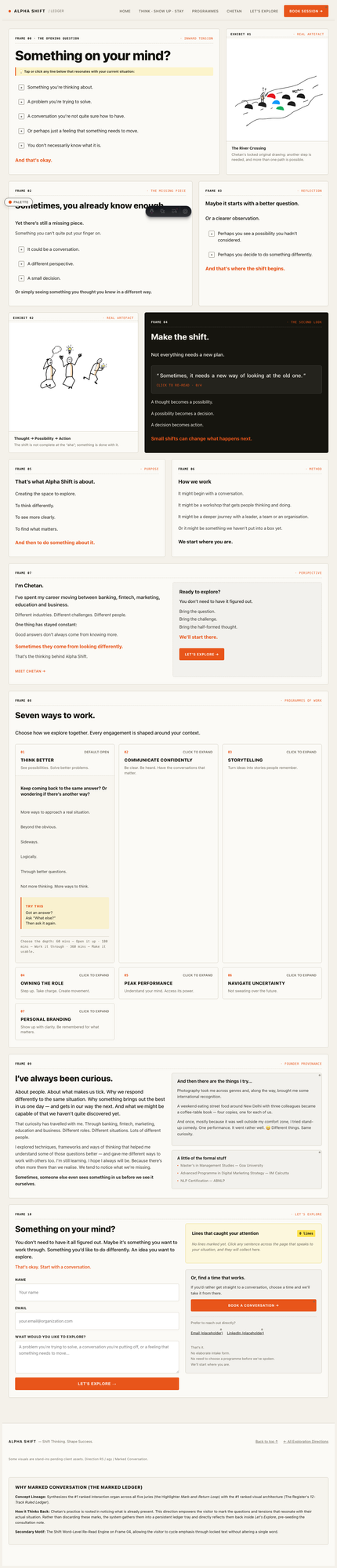
The field's crown-jewel interaction set inside opus's strongest structure: the visitor marks the lines that sound like them with a highlighter sweep, and those marks return above the booking route so arriving at the conversation reads as their own conclusion. It joined Highlighter's mark-and-return (every jury's top interaction) to The Register's visual system. It taught that the highest-value mechanic and the strongest geometry could be the same page, with 44px line targets and no dwell triggers.

R5 full builds

Preview of The Marked Conversation (r5/agy)

The Marked Conversation (r5/agy)

agy

A 12-track architectural ledger integrating interactive thought-marking and session-persisted recall chips. Refined tactile memory mechanics, but interactive marginalia risked distracting the reader from the quiet authority of the executive copy.

Preview of Conversation Depth (r5/agy)

Conversation Depth (r5/agy)

agy

A bilateral conversation stage calibrating engagement duration and cognitive depth alongside Chetan founder artifacts. Proved technical feasibility of live depth switching, but dynamic re-rendering caused layout shifts that broke continuous reading immersion.

Finals - the first three

D1 - The Marked Conversation

claude, on a codex-ui base

Mark up to three of Chetan’s lines while reading; they return as your conversation opener. The mark-to-message round trip proved the most content-native interaction of the exploration and was inherited by every later candidate.

Finals d1-d3

Preview of D2 - The Second Answer

D2 - The Second Answer

codex

D2 made the canonical “What else?” prompt the premise and produced the finals field's most visually forceful answer. It failed by repeating that recursion, turning visitor input into display material instead of useful handoff, and allowing poster scale to damage reading, including a visible desktop collision; the field kept the premise only as one voluntary moment after relevance is earned.

Preview of Motion Calibration Lane (Finals)

Motion Calibration Lane (Finals)

agy

Governed the dedicated Motion Calibration Lane across the three finalists, codifying the studio-wide Reference Calibration Table (0.5s-0.7s entrances, power3.out, 0.25s micro-interactions). Exposed severe timing drift across worktrees that required manual enforcement.

Finals - d1-d3

Preview of D3 - The Living Line

D3 - The Living Line

opus

The recompose of the winning parts into one client direction: a single continuous line you travel that inks itself in as you scroll, the two real sketches as its milestones, and the lines you notice woven back as "what stayed with you" before Explore. Memory as prose, not a tray or cards. Honest note: an early build twitched the travelling mark on reflow (the "D3 bug"), which the fresh-lane One Pen fixed by moving the node to viewport coordinates.

Fresh round - the convergence lesson

The Ink That Reads With You

claude

Built after all four ideations converged blind on the same ink organism. Good page, wrong lesson: four flavours of one idea. Prerit’s verdict on this round ("diverge ffs") produced the territory system that followed.

Fresh round

Preview of One Pen, Never Dry

One Pen, Never Dry

opus

A fresh-eyes rebuild: the page is one continuous ink line drawn by Chetan's pen, with a breathing pen-node on a left rail that warms to orange when insight lights the bulb, knots each time a line is kept, and comes to rest in the message field. It kept the D3 memory idea but corrected D3's reflow twitch by anchoring the node to viewport coordinates. It taught that the companion mark could carry idle life, colour and memory at once without becoming a scrollbar.

The Curious Stroke

codex

The Curious Stroke closed one semantic circuit from question to sketches, programme notches, held thoughts and a non-destructive enquiry handoff, with the field's strongest copy and accessibility discipline. It also proved that correctness and continuity are not enough: the centred reading river stayed too polite, produced no unforgettable visual peak, and originally left screenshot evidence uncaptured because the lane had no approved browser surface.

Preview of The Living Illuminated River (fresh/agy)

The Living Illuminated River (fresh/agy)

agy

An expressive narrative river combining fluid ink dynamics with luminous typographic milestones. Pushed organic kinetic storytelling to the boundary, but failed by drifting into whimsical agency aesthetics that lacked institutional board-level weight.

Divergence - five territories

Preview of ONE INK

ONE INK

claude (the Chetan-composite obligation)

The decoded composite carried properly: hand-ink spine entering the real sketches, colour arriving at the bulb, marks that knot into the line. Shipped with a cold-load crash every ranker unknowingly judged - found and fixed by the said-vs-shipped pass.

Preview of The Conversation Changes Shape

The Conversation Changes Shape

codex ui (Codex Desktop)

Unanimous #1 from all four rankers: the only build where Chetan’s method IS the experience - choose a situation, move through his three questions, carry the one that lands into the conversation. Became the ensemble’s chassis.

Divergence - div/*

Preview of The Diagram Is the Content

The Diagram Is the Content

opus

The divergent read of the one reference Chetan praised (visualizevalue) taken literally: each idea carried by one precise line-diagram, not a paragraph. Its signature is the bounded shift operator at S4, four nodes the visitor drives while all copy stays legible from first paint. Insight is a structural event, the composition compresses and stays monochrome, then opens to full width and lets orange in at S3. Deep dive links to a richer telling.

Divergence

Preview of The Perspective Chamber

The Perspective Chamber

codex

The Perspective Chamber gave the field its strongest user-controlled transformation: moving a lens aligned scattered fragments, then a single rupture delivered a genuine visual peak. The experiment proved that useful interaction can carry theatre, but navy glow, gradients and abstract planes pulled Alpha Shift toward a technology product, while vertical furniture and a roughly 12,800px mobile journey weakened usability.

Divergence div/*

Preview of The Executive Broadsheet (div/agy)

The Executive Broadsheet (div/agy)

agy

Monumental Swiss architectural broadside with hairline coordinate grids, international orange accents, and complete motion teardown hygiene. Failed initial contrast on linen and leaked card hover motion before the REFINE-6 gate fix brought it to doctrine.

The Working Table - consolidation study

The Working Table

Codex Desktop (operator plane)

A deliberate consolidation essay: learn from all five without reskinning any. Three of its moves were harvested into the ensemble (tilted sketch plates, the hero card, the founder artefact strip); the rest stayed here as the comparative.

The Ensemble - one copy, five roles

Preview of THE ENSEMBLE (working synthesis)

THE ENSEMBLE (working synthesis)

all five agents, role relay - codex ui chassis, lead integrated

The pattern experiment: one working copy, five specialists owning domains (art, story, motion, engineering, integration) in relay. Carries the Conversation chassis, the working-table harvest, the meaning system, the motion doctrine and three QA cycles. The current recommendation candidate.

The Field (selection surface)

codex terminal built, lead integrated stills

The client-safe index of the six candidates with evidence stills - neutral prose, no internal language. The cleanest single entry point for a first-time reviewer.